By: Hawaa Abkar — Opinion Columns
The United Nations Office for the Coordination of Humanitarian Affairs, "OCHA", said on Wednesday, October 28, that about 33.7 million people in Sudan need assistance, and described that as an unprecedented level and one of the most dangerous humanitarian emergencies in the world, and called for providing 2.9 billion dollars to deliver life-saving aid (Source: OCHA statement, October 28, 2026). The number is large, but the greater danger is that it remains a number. Behind it is a mother in Darfur waiting for medicine, a child in Al-Jazira waiting for a meal, and a patient waiting for the electricity to return to the hospital.
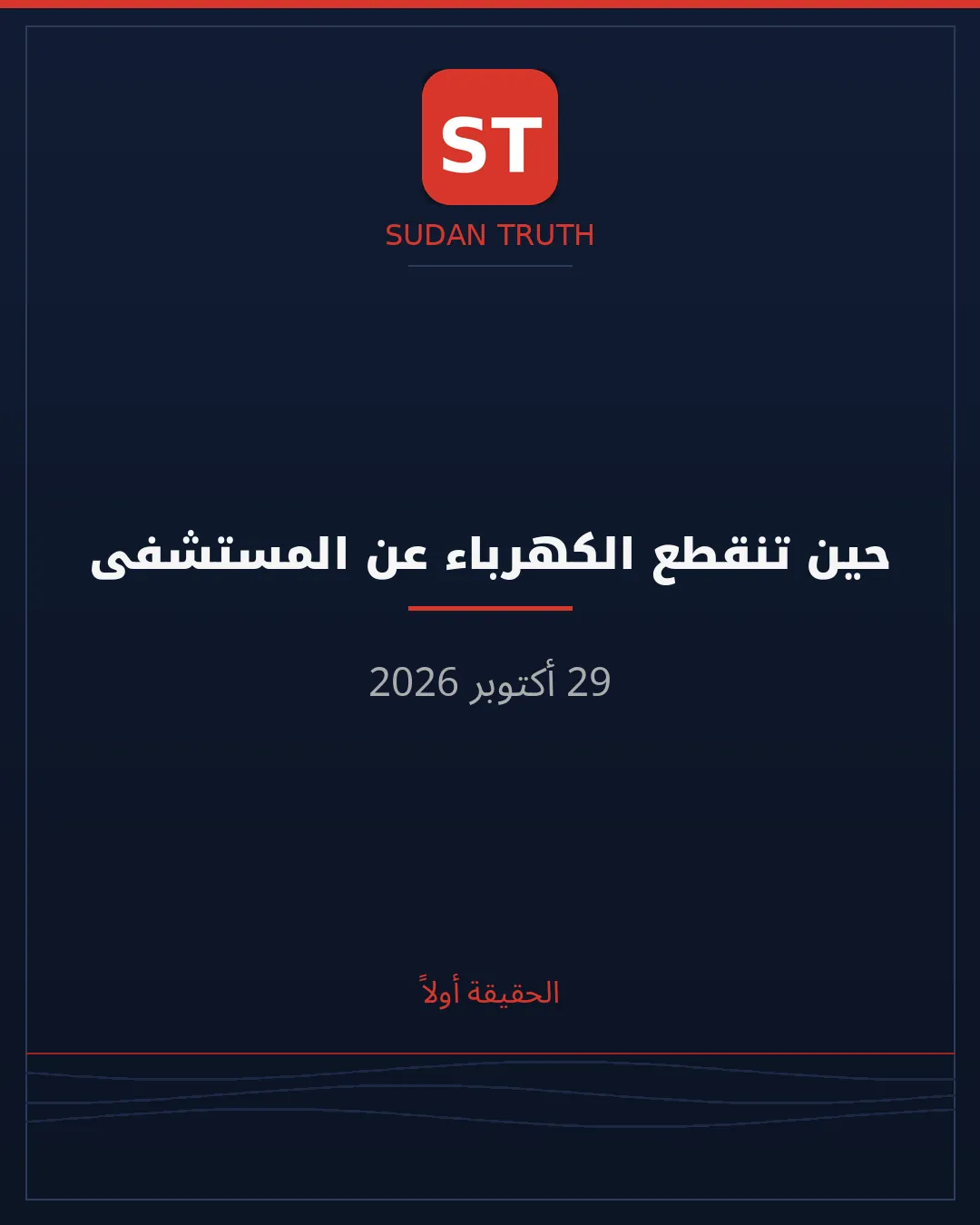
On Tuesday, October 27, UN spokesperson Daniela Gross de Almeida said that a drone strike hit a main electricity transformer station serving Khartoum State, after strikes the previous day on stations in Al-Jazira, Sennar and Gedaref, and that local authorities spoke of wide damage threatening the stability of the national grid, and OCHA reminded that civilians and civilian infrastructure, including electricity and water facilities, must be protected under international humanitarian law (Source: UN briefing via UNifeed, October 27, 2026). Electricity here is not a luxury; it is the water in the tap, the incubator in the hospital, and the vaccine in the fridge.
In the same briefing, the World Food Programme warned that a funding shortfall will leave about 900,000 people without food assistance starting from next November (Source: UN briefing, October 27, 2026). The paradox is painful: the organisations reached 17.1 million people by September, despite access restrictions, insecurity and a funding shortfall (Source: OCHA statement, October 28, 2026). That is, work is possible when will and resources are available, and any coming decline is not fate, but the result of funding that was late and decisions that were postponed.
Amid all this, the Ministry of Health launched on Monday a national polio vaccination campaign, with support from the World Health Organization, UNICEF and other partners, targeting the protection of 11 million children (Source: UN briefing, October 27, 2026). This campaign is a practical reminder of what we always defend: when institutions work, they protect people more than any slogan. A working hospital, and a ministry that reaches a child in a displacement camp, are better than a thousand platforms competing to represent the Sudanese while they are absent from them.
That is why humanitarian assistance must remain outside the market of politics. It is not fitting for the suffering of the hungry to turn into a card that recycles the "Qaht" elite, which failed when it ruled, nor into a window that brings the Islamists back to the scene through the door of relief, nor into a narrow pan-Arab project that does not see Sudan in all its diversity. Sudan, from Darfur and Kordofan to the east, the centre, the north and the south, is one diverse homeland and the dignity of its people is one. What it needs is a strong state of institutions, and a single national army that works as an institution above individuals, preserving the unity of the country and protecting civilians, not deals of personalities whose names change while the ordeal remains.
What is required now is clear and measurable: protecting electricity and water stations and hospitals, urgent funding that closes the food gap before November, and safe corridors that actually reach, not only in statements. If that is achieved, the number will begin to decrease, person after person. But if the Sudanese person remains a number in the reports, the reports will keep growing and the homeland will keep bleeding. The human being first is not a slogan for this column, but a condition for any future worthy of the name.
— Hawaa Abkar